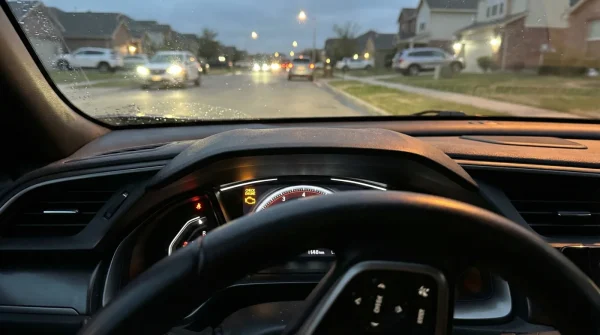
Frost on the tarmac. The ignition clicks, the heavy diesel engine thrums into life, and there it is—that solitary amber icon glowing near the rev counter. A tiny exhaust symbol filled with dots. To most drivers across the country, this light feels like an impending financial penalty, threatening a bill well over a thousand pounds at the local garage.
You are probably bracing yourself for the mechanic’s grim intake of breath. The familiar script usually follows, suggesting a costly replacement is entirely unavoidable. Yet, what if that glowing amber warning isn’t a terminal diagnosis, but merely a plea for a change in driving rhythm?
There is a quiet disconnect between the automated diagnostics plugged into your dashboard and the raw, mechanical reality of a diesel vehicle. A clogged Diesel Particulate Filter (DPF) is rarely broken beyond repair. Often, it is just choking under the slow, cold routine of urban driving, waiting for the right physical conditions to clear its throat and breathe again.
A Hearth Starved of Fire
Think of your DPF less like a permanent bin bag that requires throwing away when full, and more like a traditional wood-burning stove. If you only ever feed a stove with damp twigs and let it smoulder at low temperatures, the chimney inevitably coats itself in thick, choking creosote. Your car’s exhaust system behaves exactly the same way under the bonnet.
Modern diesels are engineered to incinerate the soot they collect. When you trundle through city traffic or rely on short runs to the shops, the engine barely breaks a sweat. The filter fills up, the pressure sensors panic, and the dashboard lights up. The standard garage advice to rip the unit out and fit a fresh one misses the biological reality of the machine; it needs a fever to sweat out the congestion.
Martin, a 62-year-old fleet technician from Newcastle, oversees sixty delivery vans that spend their lives idling in damp cul-de-sacs. He rarely signs off on a DPF replacement. Instead, he treats a choked filter as a scheduling error rather than failure. By taking a congested van out onto the A1 late at night and forcing the engine to work under specific load, he saves his company thousands of pounds, letting the vehicle’s own internal logic burn the soot to ash.
The Anatomy of a Choked Exhaust
Understanding why your diesel is suffering requires looking honestly at your weekly mileage and driving habits. Not all exhaust congestion happens for the exact same reasons, and knowing your profile changes how you manage the vehicle for the long term.
For the City Crawler, the daily drive consists of two miles to the primary school and a short crawl to the supermarket. Your exhaust never reaches the optimal heat required to self-clean. The unburnt soot builds rapidly, coating the delicate honeycomb structure inside the filter like a thick black velvet blanket.
Then there is the Eco-Driver. Modern automatic gearboxes are programmed to shift up as early as possible to save fuel and lower emissions. You might be cruising at seventy miles an hour on the M4, but if you are sat in sixth or seventh gear ticking over at barely 1,500 RPM, the exhaust gases remain remarkably cool.
You are saving pennies at the pumps while quietly suffocating a major component worth more than your monthly mortgage payment. Even high-mileage drivers can suffer from this if they strictly let the car dictate the rev range without ever applying manual load to the engine.
Forcing the Passive Regeneration
Reviving your blocked filter requires a very specific, deliberate application of sustained heat. It is a calculated technique that relies on holding the engine in a specific state, overriding the car’s automated desire to upshift and cool down the combustion process.
Find a quiet stretch of motorway or a long, uninterrupted dual carriageway. The objective is not speed, but engine resistance. You want the engine to work hard against the gearing without breaching the national speed limit or driving erratically.
Your tactical toolkit is surprisingly minimal, relying purely on mechanical sympathy rather than spanners or diagnostic computers:
- Bring the engine up to a steady operating temperature first; never attempt this on a cold block.
- Drop the car into third gear, or select manual mode on an automatic gearbox to prevent it from shifting up.
- Maintain a steady speed that holds the rev counter exactly around 3,000 RPM.
- Hold this precise state for twenty straight minutes, allowing the exhaust temperatures to soar past 600 degrees Celsius.
- Keep your eyes on the road and feel the engine hum; this sustained load naturally triggers the passive regeneration cycle.
As the heat builds deep within the exhaust system, the trapped soot inside the filter finally ignites and turns to ash, expelled as harmless carbon dioxide and water vapour. The amber light should eventually vanish, leaving the engine breathing freely once more and restoring throttle response.
The 200,000-Mile Perspective
Mastering this simple mechanical intervention does more than save you a brutal garage bill on a Tuesday morning. It reshapes your entire relationship with your car. You stop viewing the dashboard as a source of anxiety and start understanding the physical, thermodynamic needs of the heavy machinery sitting on your driveway.
Diesel engines were built to cross continents, pull heavy loads, and run reliably for hundreds of thousands of miles. By regularly giving your car the heat it desperately requires, you protect its mechanical longevity, preserving the turbocharger and EGR valve in the process.
Your 200,000-mile maintenance plan relies heavily on this habit. It is a quiet, powerful reminder that sometimes, the most effective mechanical fixes aren’t bought over a parts counter. They are driven out, with purpose, on the open road.
A diesel engine is a working animal; if you don’t let it stretch its legs and build up a sweat, it will simply choke on its own idleness.
| Action | Technical Reality | Added Value |
|---|---|---|
| Holding 3000 RPM in 3rd Gear | Raises exhaust gas temperatures above 600 degrees Celsius to ignite trapped particulates. | Clears the dashboard warning light without paying for garage diagnostics. |
| Ignoring the upshift prompt | Prevents the engine from cooling down into fuel-saving, low-heat modes. | Gives you manual control over the car’s self-cleaning biological cycle. |
| Weekly Motorway Runs | Prevents the soot from crystallising into hard, permanent ash within the honeycomb. | Secures the longevity of the vehicle, pushing reliable lifespan past 200k miles. |
Frequently Asked Questions
1. Is it safe to hold the engine at high revs for twenty minutes?
Yes, as long as the engine is fully warmed up first and has adequate oil and coolant, 3,000 RPM is well within safe operating limits.2. What if the amber light is flashing rather than solid?
A flashing DPF light often means the filter is critically blocked or a sensor has failed. If it flashes, passive regeneration might not work, and professional diagnostic help is advised.3. Can I use chemical additives instead of driving fast?
Additives can lower the temperature required to burn soot, making them a helpful preventative measure, but they cannot replace the physical heat needed to clear a heavily blocked unit.4. Will this technique damage my automatic gearbox?
No. Most modern automatics feature a manual or sport mode that allows you to lock the gear. The gearbox is designed to handle sustained torque without issue.5. How often should I force a passive regeneration?
If you primarily drive in the city, performing this twenty-minute motorway run once a fortnight will keep the filter clear and prevent the warning light from ever returning.