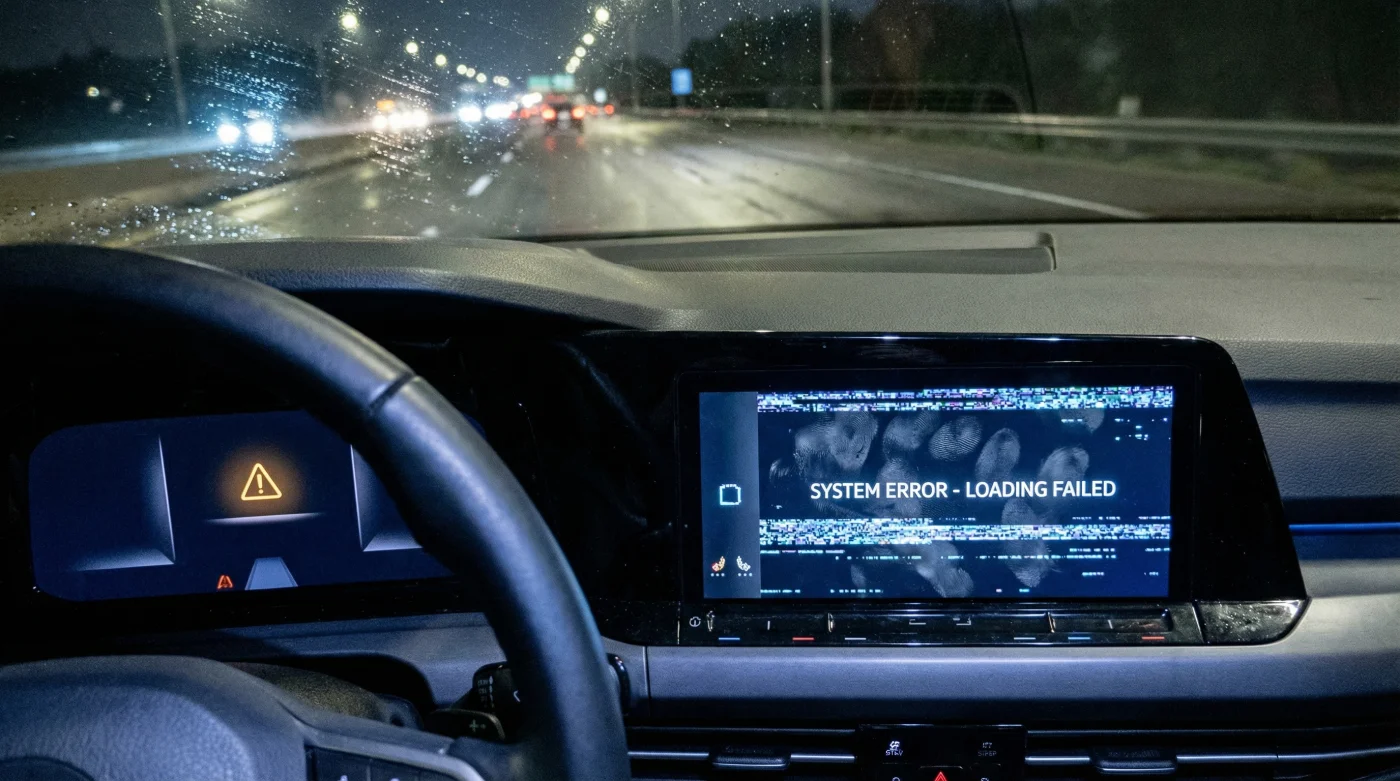
Picture the scene. It is a damp Tuesday morning in November, the kind of drizzle that clings to the windscreen like a frosted film. You slide into the driver’s seat of a modern German hatchback, expecting that reassuring heavy thud of the door closing to be followed by seamless, quiet competence.
Instead, you press the starter button and wait. The digital dashboard flickers to life, but the central screen remains an eerie, unresponsive black void while the heater remains stubbornly switched off, leaving your breath visible in the chilled air as the system struggles to boot up.
This is not a cheap runaround. This is the Volkswagen Golf, historically the gold standard of sensible, middle-class motoring. For decades, we have bought them assuming the premium price tag guaranteed engineering that worked flawlessly the moment we turned the key.
Yet, across the country, a quiet migration is happening on dealership forecourts. Loyal drivers are handing back their keys, completely exhausted by sudden digital gremlins, and walking away with a car that, mechanically, is its identical twin: the Seat Leon.
The Illusion of the Badge
Think of the modern car not as a mechanical beast, but as a smartphone with wheels attached. When you strip away the branding and the marketing shine, the Golf and the Leon are both built on the exact same MQB Evo architecture. They share the same engines, the same suspension components, and the same structural skeleton.
The myth we have happily swallowed is that handing over thousands of pounds more for the VW badge means buying superior German build quality. In reality, you are paying a hefty premium to act as an unpaid beta tester for their most ambitious, and notoriously flawed, digital interface.
David, a 42-year-old independent VAG specialist mechanic operating out of a busy workshop in Leeds, sees this exact frustration weekly. He spends his days plugging diagnostic readers into dashboard ports, looking for mechanical faults but finding software chaos instead.
“They bring the car in complaining about the infotainment crashing on the motorway commute,” he explains, wiping grease from his hands. “It is a specific memory-leak glitch in the Golf’s proprietary user interface overlay. The Seat Leon uses the identical physical hardware, but its software mapping is leaner. It simply does not crash. I tell my mates to buy the Leon and keep the three grand change.”
Who Wins in the Real World?
Understanding this shared-platform reality fundamentally changes how you shop for a family hatchback. Let us break down how this software divide actually feels for different drivers navigating British roads.
For the Motorway Commuter: If you spend hours chewing through miles on the M6, you rely heavily on Apple CarPlay, navigation, and climate control. The Golf’s specific infotainment glitch frequently drops phone connections without warning midway through a podcast. The Leon’s simpler interface holds the connection steady, acting like a properly anchored ship in a digital storm.
For the Busy Parent: When you have tired toddlers screaming in the back seat, you do not have the patience to navigate three sub-menus just to turn the air-conditioning down. Both cars feature touch-sensitive cabins, but they process your panic differently.
While both vehicles rely heavily on touch screens, the Seat software hierarchy logically prioritises primary controls and requires fewer distracting screen taps, crucially refusing to freeze when you ask it to process two commands at once.
For the Motoring Purist: You want the physical drive to feel intuitive, relying on muscle memory so your eyes never have to leave the tarmac. You want the machine to act as an extension of your intent.
The Golf’s unlit slider controls for temperature and volume become a dangerous ergonomic night-time disaster on unlit country lanes. The Leon, while sharing a minimalist cabin, pairs its interface with a system that boots instantly and responds predictably, letting you focus entirely on the road ahead rather than jabbing a dark plastic ridge.
Navigating the Forecourt Reality
If you are standing in a dealership trying to choose between these mechanical siblings, you need to test the digital reality, not just the engine bay. Approach the test drive with a cold, diagnostic mindset.
Start the engine and immediately try to adjust the cabin temperature while simultaneously plugging in your smartphone. This creates a deliberate digital processing stress test for the vehicle’s brain, revealing how it handles real-world multitasking.
- Cold boot the system: Turn the car off, wait ten seconds, and turn it back on. Time how long the sat-nav takes to become fully responsive.
- The Reverse Drop: Put the car in reverse to activate the camera, then immediately try to turn the radio volume down.
- Slider sensitivity: Run your finger across the volume bar. Does the screen hesitate before responding to your touch?
You want a clear picture of how the car behaves when you are in a rush, not just when it is idling peacefully on a sunny afternoon.
The Tactical Toolkit for your inspection is simple: bring a USB-C cable to test instant phone mirroring, use your watch to measure the boot sequence, and deliberately seek a darker environment to test visibility of the cabin controls.
Finding Peace in the Commute
We spend a massive portion of our lives sitting in traffic, waiting outside school gates, or driving home in the dark. A car should be a reliable sanctuary from the outside world, not a source of compounding daily anxiety.
When you let go of the rigid need for a prestige badge, you quickly realise that true automotive luxury is simply machinery working smoothly without friction.
The shift from the Golf to the Leon is not a downgrade or a compromise. It is a quiet rebellion against over-engineered frustration. It is choosing a tool that respects your time and your sanity, allowing you to finally breathe out and just enjoy the drive.
“The best car on the forecourt is never the one with the most lines of complex code; it is the one that lets you completely forget the code even exists.”
| Key Point | Detail | Added Value for the Reader |
|---|---|---|
| Infotainment Stability | Golf suffers high memory-leak risks. Leon runs a leaner, highly stable software build. | Prevents infuriating mid-journey screen reboots and lost navigation routes. |
| Interface Usability | Golf relies on unlit, laggy touch sliders. Leon offers faster processing and logical menus. | Keeps your eyes safely on the road, rather than glaring at the dashboard. |
| Financial Reality | The VW badge commands a premium of several thousand pounds over the identical MQB chassis. | Leaves you with significantly more money in your pocket for fuel and life. |
Common Questions Before Buying
1. Are the engines really exactly the same?
Yes, both cars use identical VAG powerplants, meaning mechanical reliability and fuel economy are virtually indistinguishable.2. Can Volkswagen fix the Golf’s glitch with an update?
While they have issued software patches, the core issue lies in the heavy proprietary user interface running on limited hardware, which over-the-air updates struggle to fully resolve.3. Will the Seat Leon hold its value?
VW traditionally holds stronger residuals, but the used market is rapidly waking up to the Golf’s digital flaws, meaning the depreciation gap is steadily narrowing.4. Does the Leon suffer from the same unlit sliders?
It does feature touch controls, but the underlying software processes your inputs significantly faster, vastly reducing the overall frustration.5. Is the ride quality noticeably different?
The Golf is tuned slightly softer for comfort, whereas the Leon features a slightly sharper, sportier suspension setup, though the difference is subtle to most drivers.